From the Archives: An Interview With Brittney Spencer


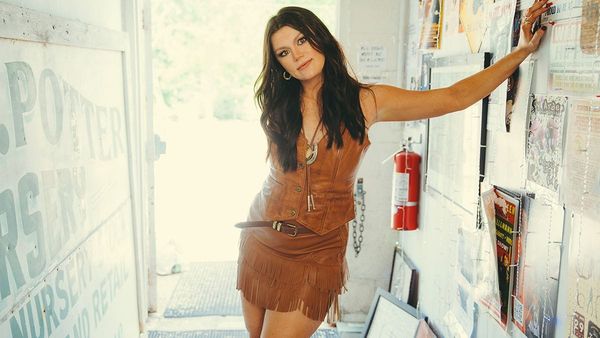
One of my favorite Nashville artists, as you may know from reading this newsletter, is Brittney Spencer (Bob Dylan agrees, so you know we ain't wrong). She's a brilliant singer and songwriter with her own take on country (that often infuses some of our other favorites, like Sheryl Crow) whom I was lucky enough to interview for my book Her Country.
Lately I've been trying to bring you some of these chats in full, because so little ends up making it into the final manuscript. I started with Patty Griffin, Natalie Hemby, Josh Abbott and now am excited to bring you this lengthy chat with Brittney - from growing up in Baltimore, to discovering country music in an unconventional way, to the women who shaped her here in Nashville. This interview was conducted in 2021.
Her album, My Stupid Life, is out now.
I know you started singing super young. When you were growing up, what were the first moments where female country artists made an impact on you?
Honestly, the first women who made an impact on me were just women in church. It was my daycare babysitter who noticed that I kept skipping nap time because I wanted to stay up and sing. She put me in her church's children's choir. That was the first time I really saw people singing. Then, just being in church and watching women play instruments, the organ and the keyboard, directing choirs and all that, sparked my interest in wanting to play an instrument one day.
A woman also introduced me to country music. My in downtown Baltimore, told me, "You need to listen to the Dixie Chicks." I thought that was so fascinating. When she put on the record, I just fell in love, and I started binge-watching CMT all the time. Once I realized what country music was, I realized it had been around me always. I didn't have any concept of genres until I was fourteen or fifteen. For me it was either church music or not church music. I'd been hearing country music on the alternative rock station in Baltimore, usually on the school bus, because they played music that was kind of neutral: nothing that was bad for me, but nothing the bus driver didn't want to listen to for two hours either. And as a crossover country act, they played Shania. They played the Dixie Chicks.
So my introduction to country music was crossover country, the country that made it more universal and appealing, so that a girl from Baltimore City could gravitate to the songwriting and to what was happening sonically. That was the impact it made on me.
That's fascinating. You hear a lot of stories about people hearing country music from country stations, but you were hearing it through alternative rock, from a different perspective, not living in the heart of Nashville or the Deep South.
Right. I was always brought up on things that cut through the alternative rock station. They played everything, John Mayer, Shania, the Chicks. Everybody knows what happens when you hear "Let's go, girls." Everybody knows what comes right after that. There was something about that that was appealing to me. It wasn't just a niche market. It was for everybody.
What was it about the Chicks especially that hit you? The musical qualities, the lyrics, all of it?
For me, the Chicks sounded like church. They sounded like what came out of singing in church. Quite honestly, in church there are things you can't sing alone, so hearing those harmonies really drew me in. Then I realized they were telling stories. It started to click for me: they're just telling stories, and it might not even be their own.
That appealed to me because I love books and poetry. The idea of telling a story in a song, paying close attention to it, not wasting a word in three minutes and thirty seconds, became that much more fascinating. My love of storytelling came from books. I'd go to the library and get interview books, because I liked to hear people tell their stories. So the idea that people did that in music was crazy.
The Chicks kind of bridged so many of my worlds. I love music, I love singing, I love harmonies, I love church, I love storytelling, and I love hearing people tell their own stories. Putting a musical component to all of those things just shook my world. Of course, you don't realize it in the moment. A lot of this is in hindsight.
When did you start trying to write songs? Did you start with poetry and transition into songwriting?
I started writing songs by writing voicemail greetings. It wasn't a trend anymore, no one was even doing it, but I don't know if you remember: you'd call somebody and they'd be singing on their answering machine. That was an activity with my friends. We found a way to manipulate technology and put three-part harmonies on an answering machine. I'd take theme songs, like the one from The Brady Bunch, and tailor the lyrics to basically say, "You called me and I'm not available." I'd sit there for a long time. I couldn't believe I'd found a way to put three-part harmonies on an answering machine without any recording devices. That was my first take at songwriting, as a sophomore in high school.
When did you start thinking about making the move to Nashville? Was that an easy decision?
No, it wasn't an easy decision. I fell in love with country music at fourteen or fifteen, but it was a few years later before I thought I might actually want to do it, and even then I didn't think I could. I looked at country music and didn't see anybody who looked like me, and I thought, there's no way I can do this. I never thought anything that's happening with me right now would happen. Honestly, I never thought I could have a career in music at all. It wasn't until I started really getting into Taylor Swift that something clicked. I thought, oh, wait, she's poetic, like me. She's from Pennsylvania. And sonically she was doing something so different. She was bridging different worlds together, I felt, maybe I can do this. Once I had that realization it still took me two years, but I eventually made the move to Nashville. So it wasn't an easy decision.
It sounds like there were pivotal moments, even before college, where you realized country music could be more than what we all assumed it was: hearing it on an alternative station, a crossover, Taylor Swift coming from Pennsylvania and writing really personal things.
Yes. Between the events I just mentioned and a lot of the moments people consider country music controversies, I've always felt the shift has been happening for a while. While everyone is arguing about whether Florida Georgia Line is country enough, I'm thinking, oh, you guys are making way for people like me. You're making way for other artists. I've always seen the opportunity. Every time someone says a certain artist isn't country enough, or country music isn't country anymore, I'm thinking that its probably just becoming way more inviting. For some people it might alienate them, because they want a particular sound to stay the same. But it's also inviting a whole lot more people to get involved in something they'd never have thought to get involved in. I think about the people who might feel left out, but I also think about the people being drawn in. It's more inviting and more diverse.
Nothing is more tiring than the "what is country music" conversation. But I love that you mentioned Florida Georgia Line in a positive light, because most of the time people freely shit on them. Whether you love them or not, they challenged the genre a little bit.
I'm here for it. Let's do it. Honestly, I don't see the problem, and it makes sense. Would we be able to see hip-hop in country, and embrace it the way we have now, years ago? I don't know. Watching the gradual shift, I think their sound has been pivotal for the direction and the invitation that country offers now.
Sorry to jump around, but you mentioned the influence of church. What about learning to play the guitar? Were there seminal teachers along the way?
I got into guitar at community college, in a guitar course, where I learned a few chords. Honestly, I wasn't great. It sounds so silly, but I had long nails and wasn't willing to give them up. When I moved to Nashville, I spent the first year not doing much. I wanted to learn the different ways you can write a song, so I found ways to volunteer and attend songwriting workshops. I also had a roommate who played shows on Broadway. She showed me a few chords, and I was ready to do whatever I needed to do to be a musician at that time, which included cutting my nails, as silly as that sounds. She taught me a few chords and I ran with it, figuring out the rest by playing and watching YouTube.
I always wanted to play an instrument. I grew up watching women play instruments in church. I play keys a little bit, just for songwriting purposes, which I think is a direct result of watching women play keys and organ in church, and a lot of R&B artists, the way they phrase when they play. I thought that was so cool. But I always knew I wanted to play guitar, because I hear songs better when I'm writing. I figure out what I want to say, and I hear it on guitar.
So your first year in Nashville was sort of just absorbing it?
Yes, absorbing the city and figuring out what I wanted to do and how I wanted to find a place here. I did a lot of random stuff. I busked downtown for two summers, which was fun. Then in my second year I decided to enroll at MTSU.
I've been going back to 2013 a lot, for some reason, because it's such an interesting year in country. On one hand you have Kacey Musgraves's debut, Brandy Clark and Ashley Monroe and Pistol Annies, all these amazing records. And then on a whole different scale you have Florida Georgia Line and "Cruise," both huge. I know it's hard to rebuild from memory, but do you remember taking stock of where country music was when you arrived?
I remember. I used to go downtown and sing on Broadway. Funny enough, somebody tagged me on Facebook in a video of me from back then. I remember busking and how popular "Cruise" was at the time, and the juxtaposition of having Florida Georgia Line and Kacey. I remember thinking, wow, country music is doing something really cool, where I could find myself in two totally different worlds, and that felt like home to me. Hearing Kacey's debut album, her first single, was just phenomenal, and at the same time I was listening to "Cruise" and thinking, what a wonderful way to be immersed in two totally different worlds in the same space.
As you became part of the songwriting community, did you feel the shift in the artists around you? Was there an openness among the creative class you were surrounding yourself with?
Not so much. Around that time, I think people were still chasing the same practices and the same sound. In my little circle, I don't think people were saying, "Oh, cool, maybe this is an invitation for me to do a new thing as well." That thought process wasn't there. In small ways, and sometimes big ways, we were watching it happen within the industry. I can say that now in hindsight, looking at the incredible amount of innovation and creativity coming out of artists right now compared to 2013. I just don't think people were there yet.
So you decided to go to MTSU. What did you feel that would give you to push things to the next phase?
I'd been a background singer since I was a teenager, in the studio and with mentors. One thing that made me uncomfortable, that I'd never really addressed until I decided to go to MTSU, was my lack of knowledge of the industry. There were a few things I told myself I would do if I moved to Nashville, and one was that I would actually understand the business. I could do the singing, but if I wanted to have a career, I needed to understand the business behind what I was doing. I wanted to be a smart artist. I wanted to know what people's jobs and roles were and have a working knowledge of a lot of different things in the industry, even as an artist.
So I knew MTSU would help me better understand the business. What I didn't know was that it would introduce me to some incredible women, like Beverly Keel, who was my professor. She taught me so much about journalism and PR and all of those things. I didn't know I would meet someone who'd have such an impact on my life, but I knew it would be a good decision, and I'm glad I followed that instinct.
When did you start to really immerse yourself in co-writing, which is such a big part of this whole culture? Do you remember your early co-writes and getting used to the flow of it?
Co-writing is an awkward process. You walk into a room with people you don't know, or someone you met at a writers' round, and strangers pour out their hearts and try to make it make sense. Getting comfortable with that, and figuring out that it's wonderful to write with everyone but more important to find your people, has been instrumental for me. Your people are the ones you can easily be yourself with. And that takes even more time.
There are so many different perspectives and talented people in Nashville. When did you feel you'd finally settled into knowing who you are artistically? I know that's probably not an easy question.
I think I figured out who I am as an artist around the time I graduated, in December [year unclear]. All of my co-writers, the people I'd been writing with for years, either stopped doing country music or left Nashville. It felt similar to the pandemic. It gave people a chance to figure out what they actually wanted to do in life. Some of my friends moved to LA, some moved to Costa Rica. A lot of people just weren't here anymore. But I had that moment in 2018 where everything stopped, and I could really figure out what I wanted to do.
I also realized in that moment that I'd probably never fit the Nashville mold, for a whole bunch of reasons. I didn't see the opportunity immediately, and I had to get over some discouragement. But eventually I saw that I could alleviate all this pressure to look and sing a certain way. I stopped wondering whether something was good enough, and I could ask a different question: is this me enough? So that's what I'm chasing. What do I want to say? What is my voice? What is my opinion, my view? What have I observed in other people that I want to put into a song? I'm constantly chasing down myself, because for the longest time I thought I had to be and do something for someone else.
That's really powerful, "constantly chasing down myself." Is it fair to say there's a line from those early moments, hearing the Chicks on an alternative rock station and learning country could be more than one thing, to now? Are those two bookends of the same story?
I would definitely say so. Hearing the Chicks cover "Landslide," from Fleetwood Mac, was a quintessential moment for me, because I realized I wanted to write songs that could be changed sonically and become a totally different thing. I like songs like that. It's happened throughout country history, whether it's Dolly Parton's "I Will Always Love You" being remade by Whitney Houston, or the Chicks doing a Fleetwood Mac song, or Shania Twain's Up!, a double-disc album. I love stuff like that. And seeing Maren put "My Church" on the same album as a song like "I Wish I Was" is so cool. Artists being able to exist in multiple spaces is so important for artists like me, because my family didn't grow up on country music. This is a new world for them, and as I tell them about the things happening with me, they're as excited as I am, and as new to it.
Little things like that have meant so much in my journey, because they let me know there's space for me. Some people like to argue about whether something is country enough. I'm wondering whether there's space for people like me, who want something a little more fluid, a little more inviting, not so rigid. We just want creative freedom. Hearing artists do that lets me know there's space for it sonically. We can break the molds, or just pretend there aren't any, because it's good music.
Tell me a little more about what Maren meant to you. You mentioned that she represented someone who pushed boundaries in country music. Did she represent another path for you?
She's been very important. I remember when she first came out. I'd heard "My Church" on the radio a few times, and I thought, let me go ahead and listen to the album. At the time I was having a discouraging season. I'd been meeting with publishers and co-writers that summer, and it was a scary time. I was at a point where I was deciding whether I wanted to continue pursuing the country music industry, because I knew my music wasn't going to change. Whatever comes out of me is what comes out of me.
I specifically remember walking from work to a friend's house, where I was staying that summer because my car had broken down. She was gracious enough to let me stay. It was a forty-minute walk every day, and I played Hero. I remember listening to each song and thinking, oh my God, there might be some space for me. There was "My Church," "I Wish I Was," "Drunk Girls Don't Cry." The production was incredible. There wasn't a single wasted lyric. Even the fun songs, like "Rich," and the love songs. It was a lot of my world coming together on a single album, and I hadn't heard that on a country record in a really long time. I listened to that album for weeks on end. Whenever I got discouraged after another meeting, I'd listen to it and remind myself that this shift is probably happening, and that I had to keep going, even if things didn't work out right now, because there might be space for me one day. But also that I had to be true to myself.
Maren has meant so much to my journey because of the risks she's taken. A year or so after that, she started being vocal online about Black Lives Matter and about gun violence. I also appreciate it when she tells people off online when they say something stupid. That's refreshing, because Nashville people are always trying to be so polite, and I'm from Baltimore. If you don't like somebody, tell them. Don't be fake about it. I appreciate that about her.
I think Hero will be one of those albums we look back on the way we look back on any other pivotal moment in country music history.
Absolutely. And as a new artist, I look at Hero, her first album, and I look at Kacey, and I think, damn, they came out of the gate being themselves. They weren't trying to fit a mold. All of us have huge ambitions. We want to be on the radio, we want to do all these wonderful things. But the idea that they did it on their own terms, in their own way, especially on their first try, is something really brilliant and special. As a woman in country music, that's what I want to do.
And I think that's how we'll be talking about Mickey Guyton's album, except it's ten years in the making.
Definitely. And it hasn't been the easiest road to get to that point, which puts a whole other terrifying spin on that decade. I'm so inspired by Mickey's story, and I tell her all the time that she's an actual beacon of light for so many people. I don't know that there's a Brittney Spencer without Mickey, without Rissi Palmer, or Linda Martell. I'm so grateful for what she does artistically, and for her being brave and bold enough to tell a truth that not many people wanted to hear, in the most brilliant, exquisite way. If you boil country music down to what it's supposed to be, if it's supposed to be anything at all, it's supposed to be about the truth. She told the whole truth and nothing but the truth.