'An Old Cowhand,' Sonny Rollins, and Jazz and Country Music's Overlapping History

Who's a real cowboy? The question has been central to American culture (popular and otherwise) for almost as long as it's existed, filtered through novels and songs and (of course) endless Westerns, where myths around the tough, rugged and macho American West were consolidated by posh creative types in Hollywood (hey, it is still the West!). It remains a fixation of country music, where the aura of cowboy is embraced from sea to shining sea and guarded closely by self-appointed arbiters of dubious credibility like, most recently, Gavin Adcock and anyone else who feels sure they're more country or cowboy or legitimate or effortless than the next guy (so, almost everyone).
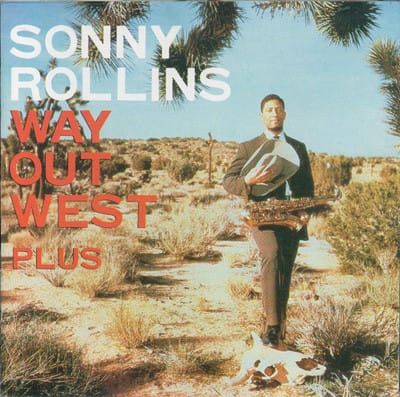
Real cowboys, as imagined, don't exist; if they did, though, Sonny Rollins was one. Steadfast, independent, resolutely original, fearless, timeless. He claimed the title, more or less, on his 1957 album Way Out West which — if I may be so bold as to quote myself — "looks like a novelty and sounds like transcendence." It was almost surely intended and received as the kind of joking wordplay and visual gag quite common in that early generation of LPs, Rollins having recorded the album in Los Angeles (the West) instead of New York and thrown a couple cowboy songs in with his more conventional array of standards and originals to celebrate. On the cover, he's pictured in a cowboy hat and holster, standing in the desert — a pointed rebuke. "Yes, a Black cowboy," he seems to be saying without words; a joke for those clueless souls who think it's funny.
The music is timeless, sweeping, flawless — one of the bestselling vinyl reissues of all time according to a random person on Bluesky. The cowboy songs, "Wagon Wheels" and "I'm An Old Cowhand," both begin with a bit of a wink and a nudge before Rollins uses them as a jumping-off point for something totally new (and totally serious, insofar as Rollins' exuberant playing can be "serious").
On its face, a cosmopolitan jazz musician dressing up as a cowboy and recording cowboy songs looks like both a bit and a subversion. But both of these songs were products of Tin Pan Alley-bred songwriters, urbanites' silver screen-hued view of the Wild West. Their original recordings are just as, if not more indebted to the still burgeoning jazz tradition as actual traditional cowboy songs. "I'm an Old Cowhand (From The Rio Grande)" was a massive hit before Rollins recorded it — specifically in the hands of the biggest pop star of all time, Bing Crosby, who'd minted the classic 21 years earlier. Crosby recorded it backed by the Jimmy Dorsey Orchestra, a seminal big band; in the Western Rhythm On The Range, which the song was composed for, Crosby performs it alongside both trumpeter/singer Louis Prima and the Sons of the Pioneers — jazz, Western and pop music all blended into one. (For more on the overlapping worlds of jazz and country, click here.)
To confuse matters further, the song is an indictment of city slickers despite being penned by one such city slicker, reportedly inspired by a cross-country road-trip taken by its author, Johnny Mercer. He thought it was funny that the cowboys he saw clad in big hats and tall boots were driving pickup trucks (!) instead of riding horses, and so decided to mock "a cowboy who never saw a cow" and who learned cowboy songs "on the radio." Everyone's a critic when it comes to who really walks the cowboy walk, it would seem, even big city songwriters. 90 years later, we have songs (also written mostly by city slickers, Nashville being a city!) about how only the real country folks love their pickup trucks; it's all relative. We dove into city slicker lore a little bit with the movie Cowboy From Brooklyn — there's a long tail there.
The recordings that immediately followed Crosby's were similarly jazzy; the Sons of the Pioneers version (which included iconic screen cowboy Roy Rogers) is practically a Django Reinhardt tune. Perhaps it's all a metacritique of the titular cowhand's lack cowboy cred?
Regardless, Rollins transformed this pop-jazz-hillbilly riff by and mocking city slickers into a jazz standard. By the '50s, he and his peers were well-versed in the art of transforming pop kitsch into something else, remixing — if you will — tunes already embedded in the public imagination (and this one is oh so catchy) into new art. It would subsequently be recorded by artists including Jimmy Smith, Grant Green, Duke Pearson and Donald Byrd, all riffing beautifully on its core goofy tension.
If cowboys and their trappings are often funny, their braggadocio ripe for deflating and their costume and mannerisms perfect for parody, Rollins found the kernel of something true underneath all the myth and pomp. Because he really was that guy, he didn't have to worry about whether he had the juice or not. He just played, always finding new frontiers with his horn. We have a wider horizon because of it.