On John Henry, American Epic Poem

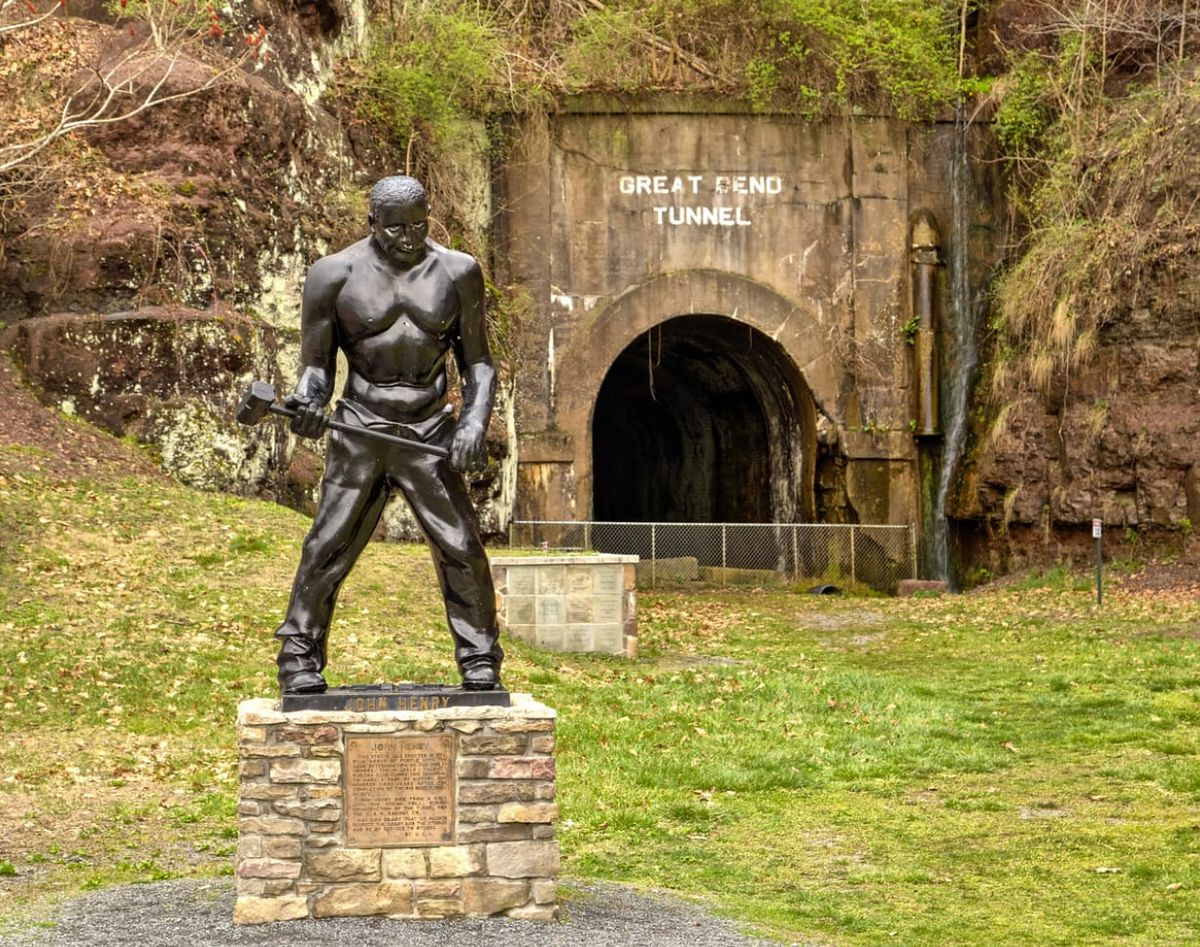
It's a nice idea that "This Land Is Your Land" should be our national anthem, a wonderful song full of generous and idealistic sentiment that's actually easy to sing. (That the Star-Spangled Banner should be replaced, I think, is a truth universally acknowledged — I'm sure especially by those who face the likely humiliation of singing it.) But the truer one, the one that speaks to our collective inability to stop repeating the sins of our forebears and the ultimate inadequacy of even the brightest and boldest among us when it comes to making our long violent history actually past, is "John Henry."
I'm not actually certain what my first encounter was with John Henry, whether it was the story or the song or something else that I came across while I was in college. But the song is how most people have learned the story; the discourse du jour may be about the Odyssey, but we have our own epic poetry that has been sung through generations. It's about a man, almost certainly Black, who was so strong and tenacious that he believed he could carve out railroad faster than a machine. He did — the man actually beat a machine (according to the legend, at least) — and it took so much from him that he immediately died. It struck me as both incredibly telling that this story and song were so enormously popular, and unbelievably tragic; I did some cursory research and learned about John Henryism, a haunting theory about how the systemic discrimination faced by Black people — the fact that they so often have to work much harder to get less — in this country can manifest in worsened cardiovascular health (among other effects). Just one thread, but a heartbreaking one that stayed with me.
Every time I hear a new version of the song — and it happens all the time, it's been covered by hundreds of artists in an array of forms ("The Ballad Of John Henry", "Nine Pound Hammer", "Take This Hammer" etc.) — I'm hit anew by just how rich and relentlessly dark this story is. John Henry's death is foretold; since he was a literal baby, he knew that "this hammer's gonna be the death of me." There are many verses to the song, but one of my favorite interpretations, by the brilliant Cécile McLorin Salvant, finds John Henry's end with him begging for a sip of water before he dies. There is no redemption in hard work and sacrifice and even being better than the robots; you just kill yourself thinking there might be. If there is an optimistic read of the song, it is that John Henry knew as much and still fought the power and beat the machine anyway. It was righteous and just, for a moment.
What does this have to do with country music? Well, John Henry has no genre besides Black American Music at its most literal, but country and folk artists have been playing the song since long before those genres had names. It lived as a ballad and a work song, soundtracking domestic labor, campfire and porch leisure, and the backbreaking forced work of incarcerated and exploited people before the pop music industry emerged in earnest. The earliest recordings of the song are concurrent with the earliest recorded American pop, period; before the Bristol sessions, Fiddlin' John Carson and Uncle Dave Macon were recording John Henry in hillbilly style. That an enthusiastic Klan member and son of a Confederate general who recorded unprintably racist music, respectively, were among the first to commit this story to wax is just one more element of its core, haunting dissonance.
It is odd to me, honestly, that the song has been so widely embraced by mostly white country, bluegrass and folk musicians over the years. It's often performed at a quite rollicking tempo (like this Doc Watson rendition, for example) that can feel almost mocking of its tragic story; I think this is traditional more than sinister — Rhiannon Giddens and Justin Robinson's recent version is uptempo, and there are few interpreters I'd trust more. It still chafes a bit to consider the way that a Black folk hero's tale became most often conveyed by white singers along the country/folk axis. Maybe they just show insufficient reverence, to my ear? Or they've heard the song so often its lyrics cease to have meaning?
White musicians capitalizing on Black music, of course, is foundational to country music as it is the rest of American pop, and John Henry's tale has been through the churn of love and theft for much longer than almost any other. I am hardly an expert on this topic; there are many books on it, including the one I am perpetually recommending: Colson Whitehead's John Henry Days. It is fiction, but the depth of his research is astonishing and educational; his imagined illustration of a Jewish immigrant songplugger hearing a bum singing "John Henry" on the street and knowing he'd struck gold is etched in my mind, as is the one of a young girl on Striver's Row in Harlem whose mother won't let her play "John Henry" because it's too declassé. (I'm not the only one; Greil Marcus, among others, has written about the book multiple times.) I was lucky enough to interview Whitehead about his new book (in which he does sneak in a John Henry reference!) Cool Machine for Defector; he sort of shrugged off my praise of John Henry Days, but did say that his favorite version while he was writing was by Johnny Cash (I believe this one, though he did also record it live at Folsom Prison):
A demo version:
Here's John Lee Hooker's version, which Marcus has written about:
Does this rambling "essay" (generous) have a point? Maybe not; just a little entry on one of the most important songs in the country and American canon. You could probably spend a lifetime trying to make sense of John Henry and the significance of his story and how it's moved over the past century and a half; chances are I will.