Country Cinema: 'Cowboy From Brooklyn', 'A Face In The Crowd' and The Long Tail of Imagined Authenticity

Every generation has its own ideas of what is real — yet every generation still seems to pin those ideas to country, folk and roots music. Right now, what feels the most real to most people, it would seem, are short form videos of white men standing in forests playing acoustic guitar while they sing about topics just forcefully enough to feel bold without actually saying much at all.
But this is just a moment, one iteration of country's "constructed naturalness" as Diane Pecknold put it in the introduction to The Selling Sound. Imagined authenticity, as we've so often discussed in this newsletter, is country's common thread even more so than any aesthetic or lyrical tradition — or just plain old authenticity, as Richard A. Peterson defines it in Creating Country Music: Fabricating Authenticity: "a socially agreed upon construct in which the past is to a degree misremembered." "Make America Great Again," indeed.
Seeing the genre depicted on screen just drives home how deep country's "realness" has run — no matter one's musical preference — over the past century or so. Revisiting Nashville (1975) was an eerie reminder of how country aesthetic as political cudgel has remained constant (what was the final scene if not the "All-American Halftime Show"...); recently, I saw two more movies that use country music (or the idea of it, anyway) as centerpieces for stories about the juxtaposition of the urban and the rural, commercialism and sincerity, real and fake.
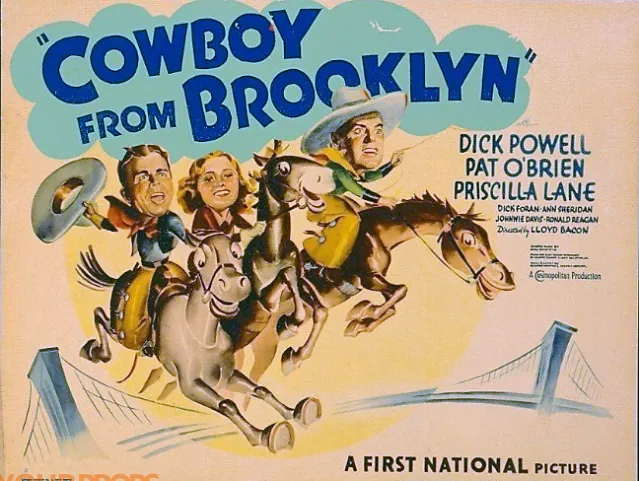
Cowboy From Brooklyn (1938) is a goofy comedy centered on a singer from Brooklyn hoboing his way across the country who — in a series of unfortunate events — winds up looking for work at a dude ranch in Wyoming. He's got such a great voice that they're happy to have him on to entertain the city slickers. The only challenge, of course, is that he's a city slicker himself, not only dressing and talking all wrong but terrified of all animals (including but not limited to squirrels). The ranch's charming lass takes it upon herself to teach him how to walk and talk and dress, to say "howdy" and "y'all" and sing cowboy songs (that still sound quite jazzy, in the lineage of the music Hilary Gardner has been reviving).
Even before that, though, the constructedness of it all is centered with a hearty wink. She and her Ma and Pop talk about having to exaggerate their own country bona fides for the benefit of the dude ranch patrons — stretching their legs to walk bowlegged, and generally acting more podunk than they actually are. Of course it winds up with the aforementioned city slicker becoming a national sensation under the name Wyoming Steve Gibson, riding (pun intended) his new country performance skills and their believability to fame and fortune; the climax is when there's a threat of his Brooklyn roots being exposed, and through a hypnotist (really) he's able to overcome his fears to ride in a Madison Square Garden rodeo so that no one is the wiser that he's not, in fact, an ol' cowhand from the golden West.
A Face In The Crowd (1957) — a remarkable Elia Kazan film and Andy Griffith's silver screen debut — centers on a country star whose trajectory is the inverse. Griffith's Larry Rhodes begins the film as an Arkansas troubadour stuck in a small town drunk tank with nothing but his guitar; he gets a crack at radio, which he uses to shout out the hardworking housewives listening. That little bit of proto-feminism gets everyone riled up and propels him towards an eventual stardom, and along the way he breaks all convention by being so "country," including ruffling ad men and media executives' feathers and crossing race lines in a Memphis TV appearance. With money and fame, though, "Lonesome Rhodes" — whose music is much more along the lines of a country blues via Greenwich Village than what Nashville was making at that moment — starts believing his own hype, doubling down on the kind of folksiness that accounts for his broad appeal and abandoning the ways he might have previously challenged the country persona people projected onto him.
By the end he is literally consulting on political campaigns with a kind of Trumpian-ignorance-as-ideal; the only difference from our current political climate is that when he's exposed insulting the intelligence of his fans, they actually turn on him. Country as real as pathway to success, again, enshrined in media — believability as currency, above all.
So when Gavin Adcock calls Charley Crockett a "cosplay cowboy" and Paul Cauthen calls him a "pathological liar," they're trying to hit him where it hurts — in country, even though it's all fake, there's nothing worse than being a fake. The persona, which Crockett, Adcock and Cauthen have all cultivated, must paradoxically combine an entertainer's charisma with some kind of believable rootsiness, and Black, brown and mixed race artists like Crockett bear the brunt of that burden of proof. That's why it seems extra significant that just after the Grammys, as Crockett's star appears to reach a new zenith, he took the chance to make his political leanings explicit rather than leaning on convenient myth: "They keep saying I’m a cosplay cowboy but they love a cosplay president," he began on Instagram, before explicitly calling out people like Elon Musk and Peter Thiel as the grifters they are, along with Trump himself.
Naming names and aligning yourself with one side over another — that's real, especially in a genre where artists, perversely, claim a "can't we all get along"/Kumbaya mentality when the political shit hits the fan when they're not explicitly aligning themselves with authoritarianism (we're all still waiting on the Jellysburg address, right?). Country music has always been about putting on a show, but there's nothing performative about taking a stand against fascists (hey, I also just rewatched Casablanca). The truth is we're all somewhere between what we are and what we say we are, and the difference, of course, is what we do. Put three chords behind that!